A FAFSA appeal is won or lost on documentation. For the 2026-27 award year, every packet needs three core documents — a signed request letter, the income already on your FAFSA (your 2024 tax return), and a documented projection of your current-year income — plus three to five pieces of proof specific to your circumstance, such as a layoff letter, a divorce filing, or itemized medical bills. The goal is a complete packet that lets a reviewer verify your situation without asking for more. This guide lists exactly what to include, scenario by scenario.
Why does documentation decide your FAFSA appeal?
Because federal rules require it. A financial aid administrator who adjusts your FAFSA data under Professional Judgment must document the reason for the adjustment in your file. The office cannot approve your appeal on your word alone — it needs paper it can point to, so the packet you submit is effectively the decision material.
The FSA Handbook is explicit that Professional Judgment is exercised case by case and that the school must keep documentation supporting each adjustment (FSA Handbook 2026-2027, AVG Ch. 5: Special Cases). That requirement works in your favor once you understand it: a request that says “we lost income” gets questions, while a request with a layoff letter, the 2024 return, and a documented current-year projection gets a decision. The reviewer isn’t being difficult — they literally cannot act without a file that justifies the action. Build the packet first, then write the letter around it. (For how the review itself works, see our guide to Professional Judgment.)
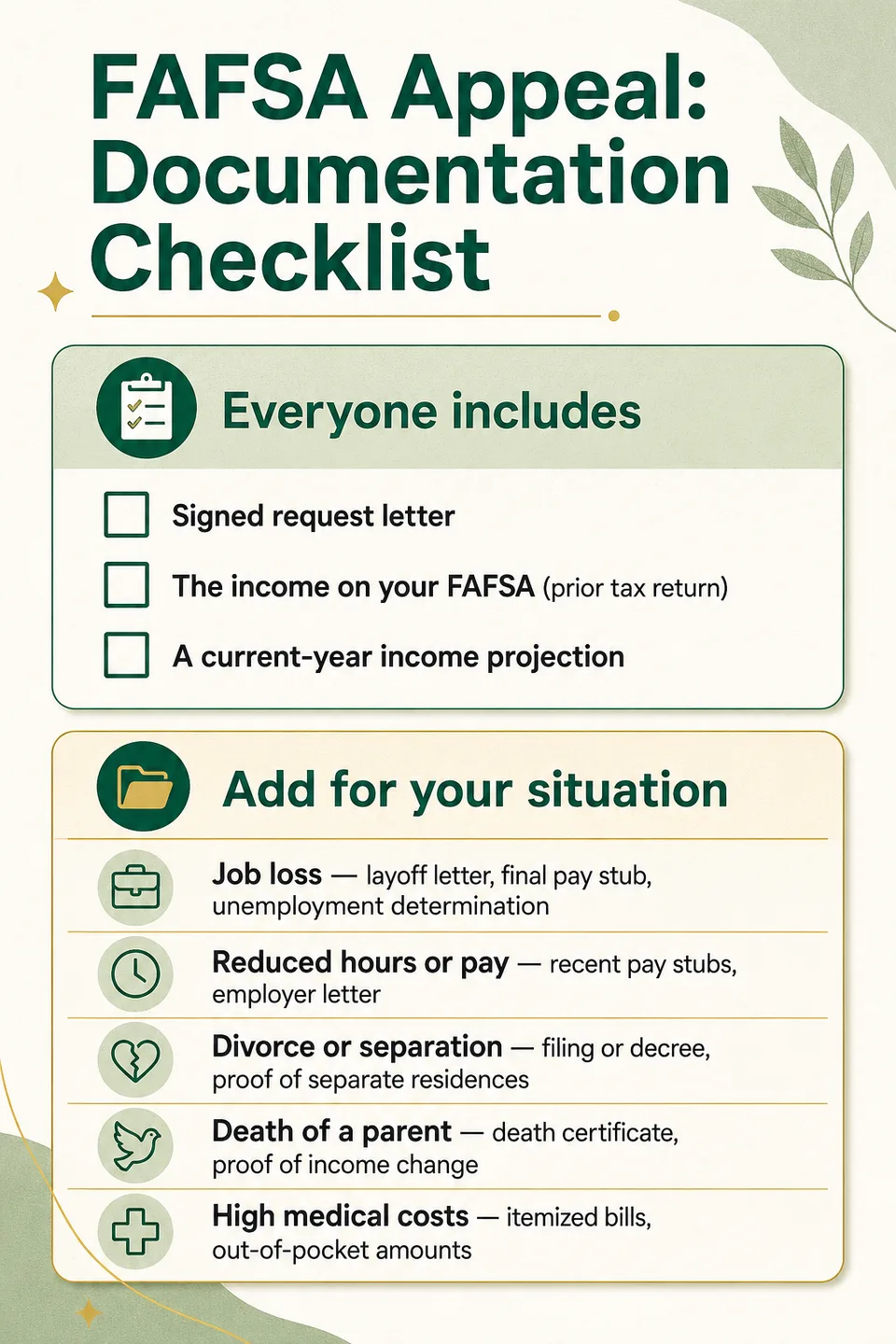
What are the three core documents every appeal packet needs?
Every packet needs three things: a signed, dated request letter that states what changed and the number you want the office to use; proof of the income already on your FAFSA, typically the 2024 tax return; and a documented projection of your current-year income with the math shown.
Here’s what each one does:
- A signed, dated request letter. It states that you are requesting a Professional Judgment review, what changed, when it changed, and the projected income figure you’re asking the office to use. See our appeal-letter guide for the structure, or download four free sample letters (PDF) to adapt.
- The income already on your FAFSA. For 2026-27 that’s your 2024 federal tax return (or a tax transcript). The reviewer needs the “before” number to measure your change against — without it, your projection has no baseline.
- A documented current-year income projection. This is the single most skipped document and the one that most often decides the outcome: a one-page statement showing what the household will actually earn this year, with the math and the supporting pay stubs or benefit statements attached. We cover how to build it line by line in the projected income statement most parents skip.
The letter tells the story, the tax return establishes the baseline, and the projection gives the office the replacement number. A packet missing any of the three forces the reviewer to stop and ask — which is exactly the delay you’re trying to avoid.
What documents do you need for each circumstance?
Match the proof to the event. A job loss needs the termination letter and unemployment determination; a divorce needs the filing and proof of separate residences; a death needs the certificate and the surviving household’s income. The table below lists three to five specific items for the six most common scenarios.
| Circumstance | What to add to the core three |
|---|---|
| Job loss / layoff | Termination or layoff letter; final pay stub showing year-to-date earnings; unemployment benefit determination; severance agreement, if any |
| Reduced hours or pay | Before-and-after pay stubs; employer letter confirming the new schedule or rate; if self-employed, year-to-date profit-and-loss plus a lost-client or canceled-contract record |
| Divorce or separation | The filing, decree, or separation agreement; proof of separate residences (lease, utility bills); the relevant parent’s own income documents; any child- or spousal-support order |
| Death of a parent or spouse | Death certificate; the surviving household’s current income (pay stubs, benefit statements); any survivor-benefit award letter; the 2024 return showing the income that no longer exists |
| High medical or dental expenses | Itemized bills; proof of out-of-pocket payment (receipts, account statements); insurance explanation-of-benefits showing what was not reimbursed |
| One-time income spike (retirement withdrawal, home sale, severance) | The 2024 return showing the spike; the document proving it was one-time (1099-R, closing statement, severance agreement); recent pay stubs showing your regular ongoing income |
Two notes on the table. First, the one-time-spike scenario runs in the opposite direction from the others: you’re not proving income fell after 2024 — you’re proving 2024 itself overstated your normal earnings, so the document that isolates the spike is the whole case. Second, if your situation is about who counts on your FAFSA rather than money — abandonment, an unsafe home — that’s an “unusual circumstance” with a different documentation path; see special vs. unusual circumstances.
Do you need the school’s special-circumstances form?
Yes, if the school has one — and many do. Financial aid offices often publish a special-circumstances or appeal request form on their website, and some will not open a review without it. Check the aid office’s site first, complete the form exactly as asked, and attach your packet to it.
The form matters more than it looks. It routes your request into the office’s actual workflow, and it usually tells you precisely which documents that school wants — which can differ from any generic checklist, including this one. Where the form’s list and this guide disagree, the form wins. If you can’t find one on the school’s financial aid pages, call or email and ask: “Do you have a special-circumstances form for a Professional Judgment request, or should I submit a letter with documentation?” That one question prevents the most common procedural rejection.
How should you organize and label your packet?
Use one rule: every claim in your letter maps to a document, and every document proves a claim in your letter. Order the attachments to follow the letter, label each item with what it shows, and cut anything that proves nothing. A reviewer should be able to verify your story without asking for more.
In practice that means three habits. Label every page — “Attachment 2: Final pay stub, year-to-date earnings” beats an unnamed PDF scan. Reference the attachments in the letter — “his final pay stub (Attachment 2) shows $14,000 earned through March” — so the reviewer never hunts. And prune ruthlessly: a stack of bank statements that doesn’t tie to a specific claim dilutes the documents that do. Three to five strong, labeled items per circumstance is typical; twenty unlabeled ones is a slower decision, not a stronger case.
A worked example: the Vega family’s job-loss packet
Consider a fictional family. Daniel Vega is laid off on March 27, 2026, from a job that paid him $61,000 in 2024; his wife Rosa earns $38,000, which is unchanged. Their daughter Maya is a sophomore at the fictional Brookfield State University, and the 2026-27 FAFSA shows the household’s 2024 income of $99,000.
Daniel’s final pay stub shows $14,000 earned in 2026 before the layoff. His state unemployment determination awards $400 a week for up to 26 weeks — about $10,400, after which he projects no benefit income for the rest of the year — so his projected 2026 income is about $24,400, and the household’s is about $62,400, a drop of roughly a third. (A real projection should use the maximum benefit amount and duration printed on the determination letter, since most states cap unemployment at around 26 weeks.) Here is how every sentence in their letter maps to a document:
| Claim in the letter | Document behind it |
|---|---|
| ”Daniel was laid off on March 27, 2026” | Layoff letter dated March 27, 2026 (Attachment 1) |
| “He earned $14,000 in 2026 before the layoff” | Final pay stub showing year-to-date earnings (Attachment 2) |
| “He receives $400/week in unemployment benefits” | State unemployment benefit determination (Attachment 3) |
| “Rosa’s income is unchanged at $38,000” | Her two most recent pay stubs (Attachment 4) |
| “Our projected 2026 household income is about $62,400” | One-page projection showing the math (Attachment 5) |
| “Our 2024 income on the FAFSA was $99,000” | 2024 federal tax return (Attachment 6) |
Six attachments, no orphans, and a stated replacement number. If Brookfield State approves the request, the aid administrator substitutes the documented projection for the 2024 figures and the FAFSA Processing System recalculates Maya’s Student Aid Index — the number that replaced the old EFC — from the corrected data (FSA Handbook 2026-2027, AVG Ch. 3: SAI and Pell Grant Eligibility). The example is illustrative; the dollar outcome in any real case depends on the family’s full picture and the school’s decision.
How do you submit the packet — and what records should you keep?
Submit through the channel the financial aid office specifies — usually a secure document portal, sometimes the school’s form or email — and keep a complete copy of everything. Record the date you submitted, the method, and the name of anyone you spoke with. Ask for the expected decision timeline when you submit.
A few specifics worth following:
- Prefer the portal over email for anything with a Social Security number, a tax return, or a death certificate. If the office only takes email, ask whether it has a secure-upload alternative first.
- Keep your own packet copy exactly as submitted, plus a one-line log: date, channel, confirmation number if any, and who you contacted.
- Follow up in writing if the stated timeline passes — a short, polite status request referencing your submission date. Our appeal timeline guide covers what typically happens at each stage.
- Expect follow-up requests. An office asking for one more document is engaging with your case, not rejecting it. Respond fast and completely.
What are the most common documentation mistakes?
Five mistakes sink otherwise valid appeals: telling a story with no proof behind it, submitting a partial packet, padding the file with irrelevant paperwork, skipping the school’s own special-circumstances form, and never stating the projected income number you want the office to use. Each one stalls or weakens the review.
Taking them one at a time:
- A story with no proof. A heartfelt letter describing the layoff, with nothing attached, gives the reviewer nothing to put in the file — and the file is what the rules require. Every sentence that asserts a fact needs an attachment.
- Partial packets. Submitting “what I have so far” usually means the request is set aside until complete — and nobody tells you it’s waiting. If one document is genuinely pending, say exactly what’s coming and when.
- Irrelevant paperwork. Bank statements, old bills, and documents that prove nothing in your letter bury the items that matter. More pages is not more persuasive.
- Ignoring the school’s form. If the office requires its special-circumstances form and you send a freestanding letter, you may have filed nothing at all in the office’s system. Check the website or ask first.
- Never stating the number. The single most consequential omission: a packet that documents a change but never says “our projected 2026 household income is $62,400” makes the reviewer do your math — or decline to. State the replacement figure plainly in the letter and back it with the projected income statement.
Avoid those five and you’ve done what most applicants don’t: handed the aid office a file it can approve without a single follow-up question. The decision still rests with the school — Professional Judgment is the administrator’s call, and it’s final (FSA Handbook 2026-2027, AVG Ch. 5) — but a complete, labeled, claim-mapped packet is the strongest input you control.
This guide is informational and is not legal or financial advice. Confirm specifics with your school’s financial aid office. Verified June 2026 for the 2026-27 award year.